
Prof. MAO Chuanbin (毛傳斌)
Professor (Global STEM Scholar), Department of Biomedical Engineering, CUHK
Director, Jockey Club STEM Lab of Nature-Inspired Precision Medical Engineering
Area of Expertise: Phage-based biomaterials, biosensors, nanomedicine, nanobiotechnology and regenerative medicine
E-mail: cmao@cuhk.edu.hk
Tel: 39435189
Twitter: @MaoPhageGroup
Location: SHB 315
Positions Available
The Mao Group is seeking highly motivated individuals to join us as postdoctoral researchers, research associates, or graduate students. Interested candidates are encouraged to email Prof. Mao with their CV and a cover letter outlining their motivation and qualifications for the position.
Nature Conference
Prof. Mao organized a Nature Conference (Hong Kong, January 10–12, 2026), working in collaboration with editors from Nature, Nature Biomedical Engineering, Nature Materials, and Nature Nanotechnology. This conference emphasized translational research in biomaterials, providing a unique forum for high-level collaboration and discussion. Attendees included leading scientists from around the world and senior editors from the Nature journals. Please watch the conference news on Nature ("How translational biomaterials could transform medicine"), Youtube (1, 2) , Wechat (1, 2, 3, 4), and CUHK Press Release (Chinese, English).
BMEMat-Advanced Materials Joint Symposium
Prof. Mao proposed, organized, and chaired the inaugural BMEMat-Advanced Materials Joint Symposium, held in Hong Kong from August 13 to 16, 2024. Co-hosted by the esteemed journals BMEMat and Advanced Materials, the symposium carried the theme "Frontiers in Biomedical Engineering Materials: Innovations for Healthcare." This event launched what has since grown into a premier international conference series.
He co-organized the 2nd BMEMat-Advanced Materials Joint Symposium, which took place from July 16 to 19, 2025, in Jinan, Shandong, China. Centered on the theme "Innovating the Future of Healthcare: Bridging Biomedical Engineering, Advanced Materials, and Intelligence", the symposium facilitated in depth discussions on next generation solutions to challenges in medicine.
He is now organizing the 3rd BMEMat-Advanced Materials Joint Symposium, scheduled for November 6–9, 2026, in Hong Kong. Under the theme "Advancing Biomedical Materials and Technologies for Global Impact," this symposium will bring together scientists from around the world to explore the frontiers of biomedical materials and technologies that can advance disease diagnosis, prevention, and treatment.
About
Chuanbin Mao is currently a Professor at the Department of Biomedical Engineering of CUHK and the director of Jockey Club STEM Lab of Nature-Inspired Precision Medical Engineering. He has been selected as a Global STEM Scholar (全球創科學人) through the Hong Kong Special Administrative Region's competitive Global STEM Professorship Scheme, a prestigious initiative designed to attract world-leading researchers in science, technology, engineering, and mathematics (STEM).
His group has genetically engineered phages for successfully
assembling nanoparticles (Advanced Materials 2009, Angewandte Chemie 2013), seeking cell-/tissue-targeting peptides (Advanced Materials 2020),
detecting biomarkers for cancer diagnosis (Nature Materials 2015, Nature Communications 2024),
inducing stem cell differentiation (Advanced Materials 2019), promoting drug/gene delivery
(Angewandte Chemie 2013, Nature Nanotechnology 2025) and tissue regeneration (Advanced Materials 2014 and 2022), and developing nano-theranostic agents (Angewandte Chemie 2022, Advanced Materials 2025). He has authored over 300 journal articles, many in leading journals such as Chemical Reviews (IF=64.2), Science (IF=47.3), Nature Materials (IF=38.0), Nature Nanotechnology (IF=37.5), Advanced Materials (IF=29.1), Nature Biomedical Engineering (IF=26.3), Angewandte Chemie International Edition (IF=17.6), Nature Communications (IF=18.1), Journal of the American Chemical Society (IF=16.6), and PNAS (IF=9.5). His scholarly output also includes one published book, 11 book chapters, and two forthcoming works: Phage Biomaterials (in press; Science Press, ISBN 978-7-03-082102-7) and Phage Therapy From Theory to Practice (in press; Royal Society of Chemistry, ISBN 978-1-83707-201-9). Some of his publications are highlighted in renowned news media (New York Times, Chemistry World, New Scientists, Science Daily, Advanced Science News, and Chemical & Engineering News). He is ranked as one of the world's top 2% scientists by Stanford University. He has been elected as a fellow of 9 prestigious professional societies (AAAS, AAM, ACS, AIMBE, BMES, HKIE, IAMBE, PMSE, RSC). He has won multiple awards, such as Global STEM Scholar from Hong Kong SAR, US National Science Foundation (NSF) CAREER award, Oklahoma New Scientist Award, and All-China Most Outstanding Doctoral Dissertation Prize.
He has served as a member/chair of ACS National Award Selection Committee. He has also reviewed grant and
award proposals for funding agencies in North America, South America, Europe and Asia, including (1) North America:
National Institute of Health (NIH), National Science Foundation (NSF), Department of Energy (DOE), Air Force Office for Scientific Research (AFOSR), U.S. Army Engineer Research and Development Center (ERDC), U.S. Civilian Research and Development Foundation (CRDF), US-Israel Binational Science Foundation (BSF), Florida Department of Health, Research Foundation of City University of New York (CUNY), Canada Foundation for Innovation (CFI), Fonds de recherche du Québec – Nature et technologies (FRQNT, Canada); (2) South America: São Paulo Research Foundation (FAPESP, Brazil); (3) Europe: German Research Foundation (DFG, Germany), Foundation for Polish Science (FNP, Poland), National University Research Council (NURC, Romania), French National Research Agency (ANR, France), Danish Agency for Science, Technology and Innovation (DASTI, Denmark), Czech Science Foundation (GACR, Czech Republic), Dutch Research Council (NWO, Netherland); (4) Asia: Ministry of Science and Technology, Ministry of Education, Research Grants Council (RGC) of Hong Kong.
He is on editorial boards for multiple journals such as Frontiers of Materials Science and Nanotheranostics.
He has guest-edited a themed issue (“Biomaterials based on phages and other viruses”) in Advanced Drug Delivery Reviews (2019).
He is currently serving as an associate editor for BMEMat.
He also guest-edited a special issue of Advanced Materials titled “CUHK 60th Anniversary,” published on January 15, 2025.
Professional Education and Training
Postdoc, Biochemistry, Bioengineering, Protein Engineering, Nanobiotechnology, The University of Texas at Austin, USA (2000-2005)
Postdoc, Materials Science, University of Tennessee at Knoxville, USA (2000)
Postdoc, Biomaterials & Biomimetics, Tsinghua University, Beijing, China (1997-1999)
PhD, Materials Science, Northeastern University, Shenyang, China (1992-1997)
Bachelor, Physical Chemistry, Northeastern University, Shenyang, China (1988-1992)
Research Interest
The Mao group is dedicated to the development of phages and other biomaterials into biosensors for detecting disease biomarkers, vaccines for preventing infectious diseases, weapons for fighting antimicrobial resistant bacteria, scaffolds for regenerating tissues, and therapeutics for treating cancer, inflammatory bowel disease, and other diseases.
Course Teaching in CUHK
BMEG5530 Tissue Engineering
BMEG5710 Introduction to Biomedical Engineering
BMEG2001/ESTR2201 Introduction to Biomedical Engineering
HONORS & AWARDS
Selected Honors & Awards:
Research Excellence Award, The Chinese University of Hong Kong, 2026
Fellow, The Hong Kong Institution of Engineers (HKIE), 2024
Fellow, International Academy of Medical & Biological Engineering (IAMBE), 2023 (Citation: For seminal contributions to nanobiotechnology by developing phages and other biopolymers into biomaterials, nanomedicines, and regenerative medicine)
Fellow, ACS Division of Polymeric Materials: Science & Engineering (PMSE), 2023 (Citation: For seminal contributions to developing phages and other biopolymers into biomaterials, nanobiotechnology, nanomedicine, and regenerative medicine)
Fellow, Biomedical Engineering Society (BMES), USA, 2022 (Citation: For achievements in the engineering of phages and other biopolymers to advance biomaterials, nanobiotechnology, nanomedicine and regenerative medicine)
Fellow, American Chemical Society (ACS), 2021 (Citation: Recognized for seminal research and discoveries in phage-based biomaterials, which have established him as a worldwide leader in this field and have significantly advanced biomaterials, nanobiotechnology, nanomedicine, and regenerative medicine)
Fellow, American Academy of Microbiology (AAM), 2020 (Citation: In recognition of outstanding contribution to the science and profession of microbiology)
Fellow, American Association for the Advancement of Science (AAAS), 2019 (Citation: For the development of strategies for the synthesis of bio-inspired materials that can be used for targeted drug delivery and cancer therapy)
Fellow, American Institute for Medical & Biological Engineering (AIMBE), 2019 (Citation: For outstanding contribution to the use of phages to develop biomaterials, nanobiotechnology, nanomedicine and regenerative medicine)
Fellow, Royal Society of Chemistry (RSC), 2017
Distinguished Junior Faculty Award, Chinese American Chemistry & Chemical Biology Professors Association (CAPA), 2010
National Science Foundation (NSF) CAREER Award, 2009 (to honor the early-career faculty who serve as academic role models in research and education in the USA)
One of 100 All-China Most Outstanding Doctoral Dissertations prize (首屆全國百篇優秀博士學位論文獎), 1999
Selected Publications
For a full list of publications, please click here.
Books:
Mao, C. B.* Phage Therapy: From Theory to Practice, ISBN 978-1-83707-201-9, Royal Society of Chemistry, 2026.
Mao, C. B.* Phage Biomaterials (in Chinese: 噬菌體生物材料), ISBN 978-7-03-082102-7, Science Press (China), 2026.
Ning, C.; Mao, C. B.* Electroactive Biomaterials (in Chinese: 電活性生物材料), ISBN 978-7-03-053839-0, Science Press (China), 2017.
Selected Book Chapters:
Wang, B.; Li, W.; Huang, S.; Wan, Y.*; Mao, C. B.* “Nucleic Acid Detection for Microbial Diagnostics,” In Nature-Inspired Sensors. 1st Edition, Edited by Hossam Haick, Elsevier, 2024, pp. 183-214.
Cao, B.; Xu, H.; Yang, M.; Mao, C. B.* “Chapter 41: Virus-Based Cancer Therapeutics for Targeted Photodynamic Therapy,” in Virus-Derived Nanoparticles for Advanced Technologies, Methods in Molecular Biology Series, Edited by: Christina Wege and George Lomonossoff, Springer, 2018, Volume 1776, pp. 643-652.
Li, X.; Mao, C. B.* “Chapter 4: Using phage as a platform to select cancer cell targeting peptides,” in Virus Hybrids as Nanomaterials, Methods in Molecular Biology Series, Edited by Baochuan Lin and Banahalli Ratna, Humana Press, USA, 2014, Volume 1108, pp. 57-68.
Cao, B.; Xu, H.; Mao, C. B.* “Chapter 10: Phage as a template to grow bone mineral nanocrystals,” in Virus Hybrids as Nanomaterials, Methods in Molecular Biology Series, Edited by Baochuan Lin and Banahalli Ratna, Humana Press, USA, 2014, Volume 1108, 2014, pp. 123-135.
Li, D.; Mao, C. B.*“Bio-inspired biomolecular supramolecular self-assemblies and their applications,” in Bionanotechnology: Biological self-assembly and its applications. Edited by Bernd H. A. Rehm, Caister Academic Press: Norfolk, UK, 2013, pp. 145-166.
Mao, C. B.*“Filamentous bacteriophages,” In Brenner's Encyclopedia of Genetics, 2nd edition, Edited by Stanley Maloy and Kelly Hughes, Elsevier Science, 2013, Volume 1, pp. 39-41.
Cao, B.; Mao, C. B.* “Chapter 10: Phage-templated synthesis and assembly of inorganic nanomaterials,” in Phage Nanobiotechnology. Edited by Valery A. Petrenko and George Smith, Royal Society of Chemistry, UK, 2011, pp.220-224.
Selected Journal Articles:
Zhao, R.; Yang, F.; Yang, T.; Li, K.; Cao, R.; Kang, X.; Chen, Q.; Li, L.; Chen, J.; Yuan, Y.; Chen, X.; Zhou, M.; Zhang, S.; Wang, J.*; Mao, C. B.* Ultra-flexible optoelectronic stimulator converts tissue-attenuated weak light into electrical signals for cardiac remodeling. Nature Communications, 2026, https://doi.org/10.1038/s41467-026-75495-7. (IF=18.1)
Wang, B.; Zhou, S.; Zhang, X.; Wang, R.; Huang, S.; Li, A.; He, H.; Zhang, Y.; Wei, Y.; Yang, Z.; Song, F.; Li, X.; Wan, X.; Shen, Y.; Ma, C.; Mao, H.; Ledesma-Amaro, R.; Yin, D.; Wei, Q.; Deng, R.; Yang, T.; Liu, S.; Wan, Y.*; Mao, C. B.* “PRICE: direct and robust detection of microRNAs at single-nucleotide resolution.” Nature Communications, 2026, 17, 2647. (IF=18.1)
Chen, H.; Song, F.; Wang, B.; Huang, H.; Luo, Y.; Han, X.; He, H.; Lin, S.; Wan, L.; Huang, Z.; Fu, Z.; Ledesma-Amaro, R.; Yin, D.; Mao, H.; He, L.; Yang, T.; Chen, Z.; Ma, Y.; Xue, E. Y.; Wan, Y.*; Mao, C. B.* “Ultrasensitive detection of clinical pathogens through a target-amplification-free collateral-cleavage-enhancing CRISPR-CasΦ tool.” Nature Communications, 2025, 16, 3929. (IF=18.1)
Mao, C. B.* “Advanced Materials Research at CUHK: From Biomedicine to Electronics and Beyond.” Advanced Materials, 2025, 37, 2418618. (IF=29.1)
Fan, Y.; Zhai, J.; Wang, Z.; Yin, Z.; Chen, H.; Ran, M.; Zhu, Z.; Ma, Y.; Ning, C.*; Yu, P.*; Mao, C. B.* “Piezoelectric heterojunctions as bacteria-killing bone-regenerative implants.” Advanced Materials, 2025, 37, 2413171. (IF=29.1)
Yang, T.; Zhang, Q.; Miao, Y.; Lyu, Y.; Xu, Y.; Yang, M.; Mao, C. B.* “Tumor-homing phage nanofibers for nanozyme-enhanced targeted breast cancer therapy.” Advanced Materials, 2025, 37, 2403756. (IF=29.1)
Yue, H.; Li, Y.; Yang, T.; Wang, Y.; Bao, Q.; Xu, Y.; Liu, X.; Miao, Y.; Yang, M.; Mao, C. B.* “Filamentous phages as tumour-targeting immunotherapeutic bionanofibres.” Nature Nanotechnology, 2025, 20, 167–176. (IF=37.5)
Li, H.; Chen, Y.; Li, Y.; Wei, X.; Wang, S.; Cao, Y.; Wang, R.; Wang, C.; Li, J.; Li, J.*; Ding, H.;* Yang, T.*; Wang, J.; Mao, C. B.* “Harnessing virus flexibility to selectively capture and profile rare circulating target cells for precise cancer subtyping.” Nature Communications, 2024, 15, 5849. (IF=18.1)
Chen, Y.; Chai, M.; Xuan, C.; Lin, J.; Yang, H.; Li, C.; Xie, M.; Ostrovidov, S.; Shi, X.*; Mao, C. B.* “Tuning the properties of surgical polymeric materials for improved soft-tissue wound closure and healing.” Progress in Materials Science, 2024, 143, 101249. (IF=42.9)
Zeng, Y.; Yue, H.; Cao, B.; Li, Y.; Yang, M.*; Mao, C. B.* “Target‐triggered formation of artificial enzymes on filamentous phage for ultrasensitive direct detection of circulating miRNA biomarkers in clinical samples.” Angewandte Chemie International Edition, 2022, 61(45), e202210121. (IF=17.6)
Liu, X.; Yang, M.; Lei, F.; Wang, Y.; Yang, M.*; Mao, C. B.* “Highly effective stroke therapy enabled by genetically engineered viral nanofibers.” Advanced Materials, 2022, 34, 2201210. (Highlighted as a dedicated story “Rebuilding the Brain After a Stroke” by Advanced Science News, 04/27/22) (IF=29.1)
Wan, Y.; Zong, C.; Li, X.; Wang, A.; Li, Y.; Yang, T.; Bao, Q.; Dubow, M.; Yang, M.*; Rodrigo, L-A.*; Mao, C. B.* “New insights for biosensing: lessons from microbial defense systems.” Chemical Reviews, 2022, 122, 8126-8180. (IF=64.2)
Yue, H.; Li, Y.; Yang, M.*; Mao, C. B.* “T7 phage as an emerging nanobiomaterial with genetically tunable target specificity.” Advanced Science, 2022, 9, 2103645. (IF=14.1)
Fang, Z.; Chen, J.; Zhu, Y.; Hu, G.; Xin, H.; Guo, K.; Li, Q.; Shi, X.*; Wang, L.*; Wang, Y.*; Mao, C. B.* “High-throughput screening and rational design of biofunctionalized surfaces with optimized biocompatibility and antimicrobial activity.” Nature Communications, 2021, 12, 3757. (IF=18.1)
Li, Y.; Qu, X.; Cao, B.; Yang, T.; Bao, Q.; Yue, H.; Zhang, L.; Zhang, G.; Wang, L.; Qiu, P.; Zhou, N.; Yang, M.*; Mao, C. B.* “Selectively suppressing tumor angiogenesis for targeted breast cancer therapy by genetically engineered phage.” Advanced Materials, 2020, 32, 2001260. (Selected as a Front Cover) (IF=29.1)
An, G.; Guo, F.; Liu, X.; Wang, Z.; Zhu, Y.; Fan, Y.; Xuan, C.; Li, Y.; Wu, H.; Shi, X.*; Mao, C. B.* “Functional reconstruction of injured corpus cavernosa using 3D-printed hydrogel scaffolds seeded with HIF-1α-expressing stem cells.” Nature Communications, 2020, 11, 2687. (IF=18.1)
Zhou, N.; Li, Y.; Loveland, C. H.; Wilson, M. J.; Cao, B.; Qiu, P.; Yang, M.*; Mao. C. B.* “Hierarchical ordered assembly of genetically modifiable viruses into nanoridge-in- microridge structures”. Advanced Materials, 2019, 31, 1905577. (IF=29.1)
Yang, M.; Mao, C. B.* “Biomaterials based on phages and other viruses.” Advanced Drug Delivery Reviews, 2019, 145, 1-3. (IF=21.0)
Yang, M.; Yang, T.; Mao, C. B.* “Enhancement of photodynamic cancer therapy by physical and chemical factors.” Angewandte Chemie International Edition, 2019, 58, 14066-14080. (IF=17.6)
Chen, J.; Ning, C.*; Zhou, Z.; Yu, P.; Zhu, Y.; Tan, G.*; Mao, C. B.* “Nanomaterials
as photothermal therapeutic agents.” Progress in Materials Science, 2019, 99, 1-26. (IF=42.9)
Cao, B.; Li, Y.; Yang, T.; Bao, Q.; Yang, M.*; Mao, C. B.* “Bacteriophage-based biomaterials for tissue regeneration”. Advanced Drug Delivery Reviews, 2019, 145, 73-95. (IF=21.0)
Ning, C.*; Zhou, Z.; Tan, G.; Zhu, Y.; Mao, C. B.* “Electroactive polymers for tissue regeneration: Developments and perspectives.” Progress in Polymer Science, 2018, 81, 144– 162. (IF=32.8)
Yang, M.; Sunderland, K.; Mao, C. B.* “Virus-derived peptides for clinical applications.” Chemical Reviews, 2017, 117, 10377-10402. (IF=64.2)
Sunderland, K.; Yang, M.*; Mao, C. B.* “Phage-enabled nanomedicine: from probes to therapeutics in precision medicine.” Angewandte Chemie International Edition, 2017, 56, 1964-1992. (IF=17.6)
Cao, B.; Yang, M.*; Mao, C. B.* “Phage as a genetically modifiable supramacromolecule in chemistry, materials and medicine.” Accounts of Chemical Research, 2016, 49,1111-1120. (IF=18.0)
Zhou, X.; Cao, P.; Zhu, Y.; Lu, W.; Gu, N.*; Mao, C. B.* “Phage-mediated counting by the naked eye of miRNA molecules with attomolar concentration in a Petri dish.” Nature Materials, 2015, 14, 1058–1064. (Highlighted as a story “Cancer biomarker counted up with the naked eye” in Chemistry World). (IF=38.0)
Cao, B.; Yang, M.; Zhu, Y.; Qu, X.; Mao, C. B.* “Stem cells loaded with nanoparticles as a drug carrier for in vivo breast cancer therapy.” Advanced Materials, 2014, 26,4627-4631. (IF=29.1)
Wang, J.; Yang, M.*; Zhu, Y.; Wang, L.; Tomsia, A. P.; Mao, C. B.* “Phage nanofibers induce vascularized osteogenesis in 3D printed bone scaffolds.” Advanced Materials, 2014, 26, 4961- 4966. (IF=29.1)
Cao, B.; Zhu, Y.; Wang, L.; Mao, C. B.* “Controlled alignment of filamentous supramolecluar assemblies of biomolecules into centimeter-scale highly-ordered patterns through nature- inspired magnetic guidance,” Angewandte Chemie International Edition, 2013, 52, 11750- 11754. (IF=17.6)
Gandra, N.; Wang, D.; Zhu, Y.; Mao, C. B.* “Virus-mimetic cytoplasma cleavable nanoclusters for enhanced gene delivery to mesenchymal stem cells.” Angewandte Chemie International Edition, 2013, 52, 11278-11281. (IF=17.6)
Qiu, P.; Qu, X.; Brackett, D. J.; Lerner, M. R.; Li, D.; Mao, C. B.* “Silica-based branched hollow microfibers as a biomimetic extracellular matrix for promoting tumor cell growth in vitro and in vivo,” Advanced Materials, 2013, 25, 2492-2496. (IF=29.1)
Ma, K.; Wang, D-D.; Lin, Y.; Wang, J.; Petrenko, V.; Mao, C. B.* “Synergetic targeted delivery of sleeping-beauty transposon system to mesenchymal stem cells using LPD nanoparticles modified with phage-displayed targeting peptide.” Advanced Functional Materials, 2013, 23, 1172- 1181. (IF=19.9)
Mao, C. B.*; Wang, F.; Cao, B. “Controlling nanostructures of mesoporous silica fibers by supramolecular assembly of genetically modifiable bacteriophage.” Angewandte Chemie International Edition, 2012, 51, 6411-6415. (IF=17.6)
Qiu, P.; Mao, C. B.* "Viscosity gradient as a novel mechanism for the centrifugation-based separation of nanoparticles." Advanced Materials, 2011, 23, 4880-4885. (IF=29.1)
Cao, B.; Xu, H.; Mao, C. B.* "Controlled self-assembly of rod-like bacterial pili particles into ordered lattices." Angewandte Chemie International Edition, 2011, 50, 6264-6268. (Selected as inside cover story) (IF=17.6)
Qiu, P.; Jensen, C.; Charity, N.; Towner, R.; Mao, C. B.* "Oil phase evaporation induces self- assembly of hydrophobic nanoparticles into spherical clusters with controlled surface chemistry in an oil-in-water dispersion and comparison of behaviors of individual and clustered iron oxide nanoparticles." Journal of the American Chemical Society, 2010, 132, 17724- 17732. (IF=16.6)
Mao, C. B.*; Liu, A.; Cao, B. “Virus-based chemical and biological sensing.” Angewandte Chemie International Edition, 2009, 48, 6790-6810. (IF=17.6)
Liu, A.; Abbineni, G.; Mao, C. B.* “Nanocomposite films assembled from genetically engineered filamentous viruses and gold nanoparticles: nanoarchitecture- and humidity- tunable surface plasmon resonance spectra.” Advanced Materials, 2009, 21,1001–1005. (IF=29.1)
Mao, C. B.; Solis, D. J.; Reiss, B. D.; Kottmann, S. T., Sweeney, R. Y.; Hayhurst, A.; Georgiou, G.; Iverson, B.; Belcher, A. M.* “Virus-based toolkit for the directed synthesis of magnetic and semiconducting nanowires.” Science, 2004, 303, 213-217. (IF=47.3)
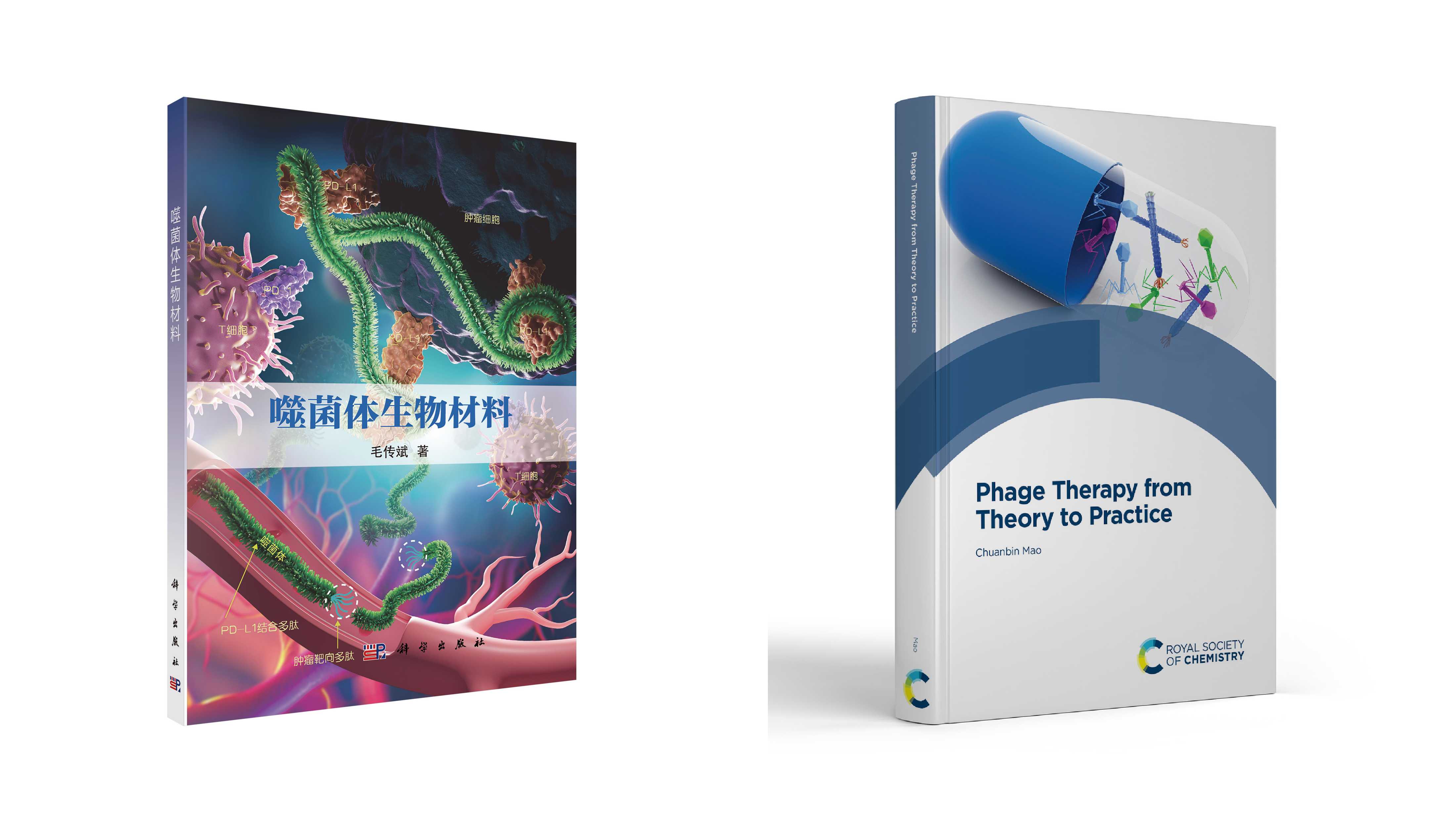
About the two books:
噬菌體生物材料
Phage Therapy from Theory to Practice